Wednesday, January 26, 2011

99 Bottles of Brunello on the Wall, 99 Bottles of Brunello ...

Last week we bottled the first batch of Brunello di Montalcino for Casa Raia! Pierre-Jean was expecting closer to 1,460 bottles and we ended up with 1,368 Brunello di Montalcino 2006.  It took us about 6-7 hours to complete the bottling and cleaning. The next day we were like a well-oiled machine and only took about 3 hours to bottle 895 bottles of Rosso di Montalcino. (photos to come later)

Here are some fun observations of the day...
  • The temperature in the cellar was around 50F so I was wearing 4 layers which included a rain jacket, fleece, hat, gloves, 2 pairs of pants, etc. And I was still cold!

  • Bottling is a 4 person job
  • Person #1 Fills the bottles
  • Person #2 Corks them
  • Person #3 Cleans them
  • Person #4  Places the bottles in the bin (and counts)


  • To transfer the wine, attach a clean hose to wine tank, then to filter, then to the pump, then to the bottling unit. 

  • Filter must have no pieces of plastic, paper, or other stuff in water or it will catch when cleaning. Our filter caught approximately 6-7 fruit flies from inside the tanks during our bottling! Eeeww.
  • All items must be clean and dry! Everything that touches the wine was cleaned with alcohol, citric acid and caustic soda.
  • The filling unit can fill 6 bottles at once.  The spout will automatically stop when filled to the right level because it equalizes and will not go higher.


  • You want a space 7cm from the top so the cork can be placed in perfectly
  • The corking machine was easy to use, mechanized and sucks air out as it deposits the cork in

  • No labels on the bottles now
  • Bottles will stand “upright” for 4-5 days to allow air to escape and wine to settle.  Then they will be placed on their side for another 4 months before being sold. 

Thursday, January 20, 2011

Hummus!

I have officially introduced my hummus to Italy.  However, the Tuscan version is the best I've ever made. It was so creamy and really delicious. Served on cut red bell peppers and carrots that were so crisp and fresh you could feel the water bursting out of them as you took each bite.

Check out the modifications to my classic recipe ... now enjoyed all over the world!

Erica's Tuscan Hummus

Tuscan Chick Peas (they are softer, more flavorful and have thinner skins)
Tuscan Lemons (juicy and fragrant)
Tuscan Garlic (yummy)
Hazelnut Butter (instead of Tahini, adds a slightly sweet and more nutty flavor)
Ground Cumin (I ground the seeds by hand using a mortar and pestle)
Extra Virgin Olive Oil (organic, house-pressed and fresh from the groves here at Casa Raia)
Parsley fresh from the garden (delicate, flavorful and grassy)
Himalayan Pink Sea Salt
Freshly ground Black Pepper
Cayenne Pepper

Wednesday, January 19, 2011

Tuscan Country Life

There have been many surprises here in Tuscany. Country living is not something I am accustomed to even though I love to be outside. Below you will find some of the interesting things I have discovered about living in the country in Montalcino!

Beautiful things...


The sunsets here are nothing short of breath taking. Between 4:30-4:45pm you want to be high on a hilltop so you can see the magic unfold before you. As the sun sets, it blankets the rolling hills in a warm pink hue. It reminds me of the sunrise on the Front Range in Colorado Springs and I get the same awe-inspiring feeling from watching it. I try to make it a daily occurrence, when it is not foggy.

Also the land itself is beautiful, especially in the winter months. Ironically, it is lush and green in the winter (due to all the fog) and dry and earthy/sandy in the summer. They cut all the grass in the summer, leaving the earth bare.

Speaking of the land here, it is so beautiful to be able to see the rolling Tuscan hills with their patchwork of vineyards, and olive groves terraced along the hillsides with stone houses dotted in between. It looks like a quilt of epicurean love! :)

People take the time to talk to each other, spend time together and they are not rushing to fit life in. Instead they let life happen and then work around it.

Recycling is easy! There is even a battery recycling box at the checkout line at the grocery store. Everyone recycles...everything! Food packages are designed with easy recycling in mind. There is little waste and lots of composting that also happens.

Surprises...


The food in Tuscany in general is purely sublime. The only exception is the bread. I know this sounds crazy but they really don't do bread well here. In Tuscany the bread is not fabulous (due mostly to lack of using salt) but in Montalcino especially, it is downright bad. Crumbly and dry with little flavor, I prefer to stick with just some cheese instead. Go figure! Just to give you an idea of how bad it is, even the dog here will not eat it. She will only eat French bread.

In a cool and VERY moist environment there are "critters" of all kinds. Spiders are extremely common. I have found a few in my bedroom, one was dropping in on us in the car today (literally), one was perched on an olive branch that I was reaching for and another was on the bag of potatoes near the sink this evening. I really don't mind spiders (unlike my sister who would be throwing her shoes at them all the time) but I do like to know when they are around.

What I do "mind" are snakes. Terrified is a more accurate term. And there are many of those here too. Saw my first one yesterday... "just" a grey garden snake. Apparently these are the good kind because they eat mice. YES, my worst nightmare of rodents is here too! But back to the snakes. The "bad" ones are the vipers! You really don't want to be bitten by a viper because they have poisonous venom that will go directly to your heart and cause you to die very quickly. I need to be on the look out for short brown vipers. Seriously?

Mud, mud, mud everywhere. It is so humid and moist here due to the fog. The ground is over-saturated in the winter, making it muddy and dewy for most of the day. The earth never really dries out. So this means that my shoes are constantly packed with muddy soles and I never have a solid grip on the ground. I think I will invest in a pair of rubber boots that go up to my knees!

This is one of the Casa Raia vineyards, looking dry and warm. Don't let it fool you! It is all mud!!

Monday, January 17, 2011

Giornata di Pici :)

I am obsessed with pici. When I was in Siena last summer, I had dreams about this pasta and HAD TO HAVE MORE! I brought it home and made it for a few friends in Colorado and also for my family before heading back to Italy this time. I have sought out WWOOF Farms that mentioned pici production. I LOVE this stuff! (In Italian I would say, “adoro i pici”). So when Kalyna mentioned that there was a day dedicated to pici, it was a dream come true for me.


Saturday, January 15, 2011 was a beautiful day in Montalcino and it was the day I learned how to roll pici like an Italian (kinda). 

First, a little info on this glorious pasta. It is somewhat like very thick spaghetti. It takes 22-23 minutes to cook the dried variety.  It comes from the Siena region of Tuscany and is nearly impossible to find in the US. In Montalcino, it is called “Pinci” because they add eggs and a bit of salt to the dough. This addition makes the dough softer. I assume they only add the salt to the cooking water. In the town of Siena, it is called “Pici” (with no “N”). In Siena, it is only made with farina (flour) and water… no eggs!

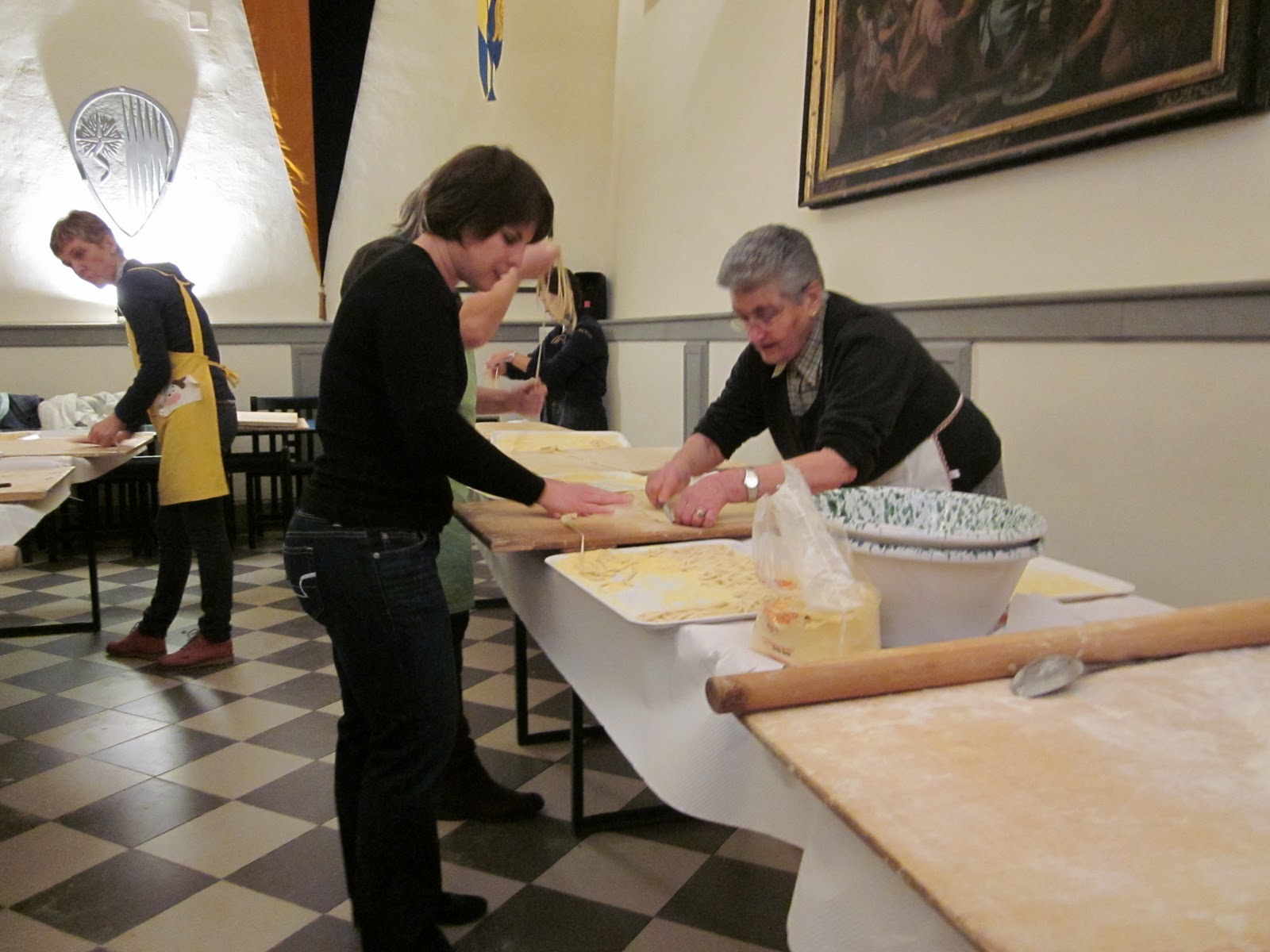
So, back to the rolling…. Kalyna, the kiddos and I went to Montalcino to one of the old churches and met up with the women of Montalcino. It was a room of mass pinci rolling!

  
To roll the pinci…
  • Knead the dough and let it rest a bit.
  •  Roll it out to approximately ¼ inch thick.
  • Cut it into approximately 1 inch thick strips.
  • On a floured cutting board, start rolling, using only the palm & heel of your hand. Don’t be afraid to apply pressure or to add a little moisture to your hands so you can get some grip on the pasta.
  •  As you roll, slightly stretch the pasta strip with the other hand.
  • Deposit the beautiful little worm-like creations onto a tray that contained finely ground cornmeal.
  • Wrap the pinci into individual nests like you would a garden hose.


So as if that wasn’t life-changing enough, there was also a town dinner that night that featured the pinci. Everyone was invited to attend. For 20 euro, you got an antipasta dish, 6 courses of pinci with all of the traditional sauces, a meat & vegetable course, tiramisu and flowing vino and aqua. What could be better?


Kalyna, Eliah and I found a perfect spot between a family and two men, both named Claudio. The dinner started at 8pm and we didn’t leave until nearly midnight! And that was when it was turning into a discotheque!  

Below you will see each of the courses and the sauces explained.

Pinci with Bolognese (meat sauce) and freshly grated Parmigiano

Pinci with Tomato, Garlic and Olive Oil Sauce (pomodoro, aglio, e olio)

Pinci with a Pork Sauce

Pinci with Broccoli and Butter Sauce

Pinci with Cheese & Pepper Sauce (Cheese is carcio?)

Pinci with Breadcrumbs ("Briciole" in Italian - this is the only one I would not recommend)


It was a heavenly experience! Talk about carb overload of the gourmet kind!

Fun Facts About Winemaking

FUN FACTS ABOUT WINEMAKING IN GENERAL

  • Sulfites must be added by law to all wines in Italy. You must add them in order to clarify the wine and also, and most importantly, to prevent bacteria from growing. Most people will add around 10 g per hectaliter, sometimes even up to 30 g. Casa Raia only adds between 2-6g, basically the minimum. It is a chemical and the more natural you can go, the better. The more you add, the more biting the flavor and trust me, you can taste it.

  • Sulfites, as well as tartaric acid will combine with tannins in the wine and drop to the bottom, creating sediment.
  • Sediment is a beautiful purple sludge that collects at the bottom of the wine container. It actually feels like a cream and is apparently really good for your skin. I think they should figure out a way to sell this stuff to cosmetic companies. Maybe winemakers already do.

  • Wine must be analyzed before bottling to ensure it meets minimum requirements and also so the vintner knows what to put on the label. The wine will be analyzed to determine the alcohol content, sulfite level, acid level, sugar level, etc.
    •  If a sulfite level is too low, you can add more.
    •  If an acid level is too low, you can add tartaric acid to increase it. This will cause a different taste and more sediment. It is better to pick the grapes when the acidity level is most desirable and avoid having to adjust later in the fermentation process. 
    • Same idea with the sugar level.
  • The name of the game in wine making is clean, clean, clean! Any wine left anywhere in the cellar, on the barrels, etc. is exposed to humid, cool air and is the ideal breading ground for bacteria. Thus most of your time in the cellar is spent cleaning up wine spills and dribbles.
  • There are two ways oxygen can harm a wine… too much exposure and too little exposure. Both cause an off flavor. You can fix “too little exposure” by transferring the wine to another container and allowing it to have more exposure to air. If it has already had too much exposure, then you can’t fix it.
  • Air tight seals are the key to success, especially in stainless steel containers. There is a band of rubber that surrounds the lid and you pump it full of air once it is placed on top of the wine. This ensures that it is sealed and has resistance, thus not allowing any air exposure.
  • Gravity is your friend when transferring wine. Any tube can be used, but place the item to be poured higher than the item that is being poured in. 

Saturday, January 15, 2011

Fun Facts About Brunello di Montalcino


  • Must be 100% Sangiovese grapes (same grape used to make Chianti but in a different region).  
  • Must be barrel aged for a minimum of 4 years and 4 months in the bottle before being able to be released for sale. 
  •  Before selling, the wine must be “tasted” by the Brunello official panel. If the wine does not have the right characteristics of Brunello, they will deny it’s naming and will "demote" it to a Rosso di Montalcino or an IGT wine (Indicatione Geographica Typica). 
  • There are 300 producers of Brunello in Montalcino.  
  • Of those 300, only 9 are organic producers. (I am on one of those organic vineyards). 
  • The cork used for Brunello should be of the highest quality, meaning that it is a bit longer than usual and much more dense.  The ones here at my vineyard cost approximately $1.10 each. 
  • Sangiovese grape is susceptible to mold diseases which are easy to get here in Montalcino due to the intense and constant fog for 6 months out of the year.

The Work

THE WORK

DAY 1:
It’s not glamorous and it is hard work, but I loved being a very small part of creating this wine and olive oil. My first day had me washing out bins. 82 of them to be exact. I was to unload, wash, rinse, dry, stack, carry and reload in the shed (approximately 100 yards away) 82 bins used for collecting grapes and olives. This may sound simple, but it is back-breaking and took me FOREVER! Seriously, it took me nearly 5 hours to do this. I was alone though so I do have that in my favor. Listened to my iPod all day while working in the sunshine, overlooking the terraced Tuscan hillsides. It was a good day. I slept very well!  And dinner was Osso Bucco with local 2003 Brunello di Montalcino (from the neighbor)!!

DAY 2:
Another 35 bins to wash out this morning. This time I got to use the heated power washer. Yeah baby! This also means that I was soaked. Wearing jeans and a fleece and my gortex Keens (wet shoes but dry feet), I tried to avoid the back spray, but was not very successful. It was also a cold and foggy day here. It is often foggy lower in the valley, but we are higher up so it doesn’t happen as much here. Today, it was foggy everywhere. And the earth is always muddy in the morning- a lot of moisture and dew here. This is “good” for the grapes. By “good” I mean that water is good, but fog frequently causes mold diseases in Sangiovese grapes, which is not good.

The second part of my day was much more interesting (warmer and dryer too as I took a hot shower and changed at lunch). We got the bottling room ready for the big event- next week we will be bottling 2006 Brunello di Montalcino! WOOHOO!!

I also helped Pierre-Jean to check and refill all of the barrels/casks (barriques) in the cellar (cantina). Here’s what I learned from this process… 

  • When using new barriques, the wine will “breathe” less as the wood is newer and sealed better, thus there will be less loss. Older barriques (2+ years) will have more loss. 
  • You need to check the level of the wine once a week in the first 2 months after putting into the barrique. If it is not touching the top, refill with the same wine that is kept on reserve in a stainless steel (airtight) vat in the same temperature and humidity controlled room. Fill to the top. For the next 4 years, you can check the level once each month (or more often if you desire).
  • Everything must be clean :) No wine drips on the outside of the barrique, or on the floor. All toppers must be cleaned and dry before replacing. No water in the wine!